
Stem Cuttings (Anatomy)
Before you take a stem cutting worth rooting, you need to know what you’re looking at on the piece of wood in your hand. The stem isn’t just a stick. It’s made of distinct parts, and only some of them can turn into a whole new plant. Once you can see those parts clearly, the rest of the work gets a lot more reliable.
The Basic Parts of a Stem
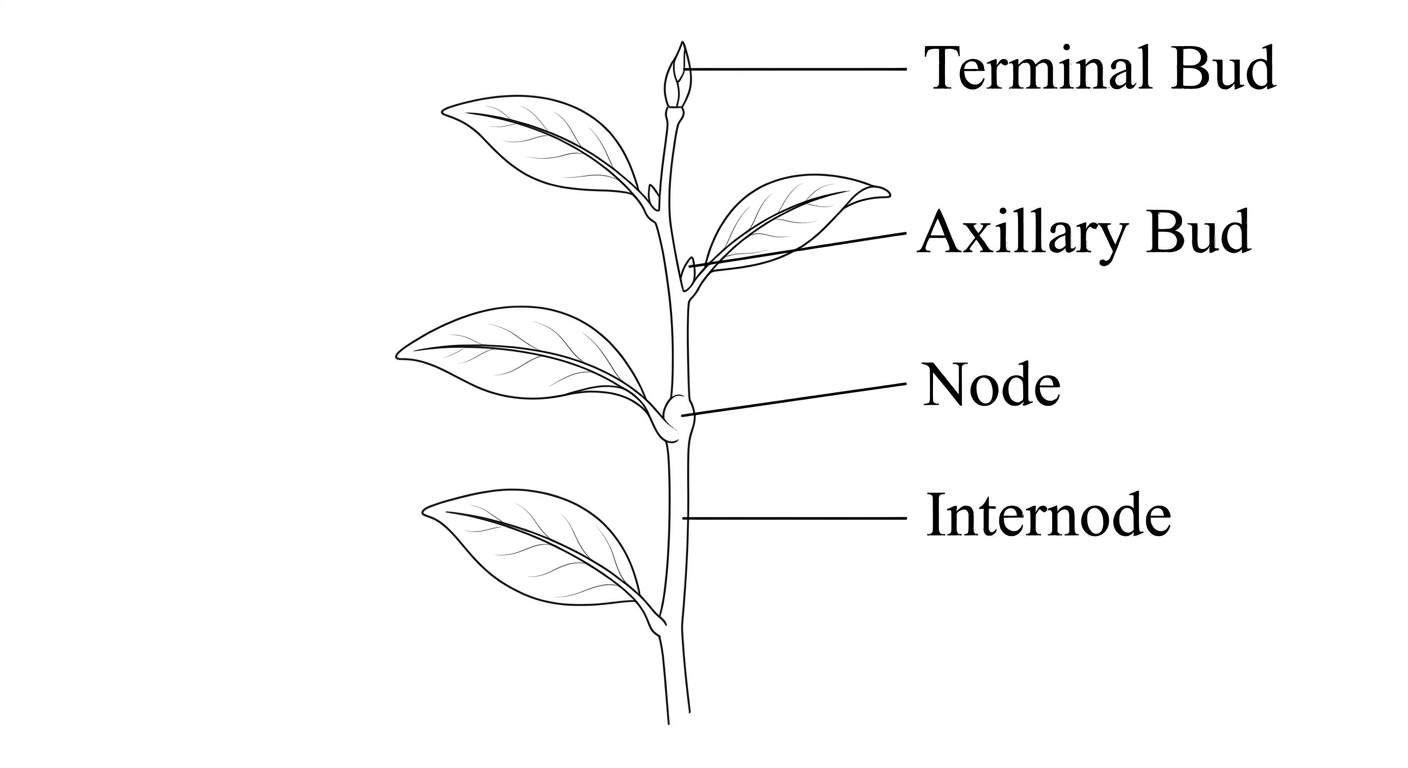
A node is the spot where a leaf or a bud attaches. That is the important place. Nodes hold meristematic tissue — cells that haven’t specialized yet — and those cells can make both new roots and new shoots. That is why every good cutting instruction tells you to include at least one node. Without it, you’re just sticking a dead stick in the medium.
An internode is the stretch of stem between two nodes. Length isn’t fixed. A vigorous shoot in full sun with steady water usually has longer internodes than a shaded or slow-growing one. New growth tends to have longer internodes than older, tighter wood. When you’re choosing cuttings, internode length is a quiet clue about how hard that particular piece of the plant was growing.
An axillary bud (or lateral bud) sits in the angle between a leaf and the stem. Given the right conditions it can push out into a whole new shoot. That is another reason a good cutting carries at least one — preferably several — of these buds.
The terminal bud sits at the tip of the stem and drives upward growth. While it is active it releases auxin, which keeps the axillary buds below it from growing. Pinch or cut that terminal bud and the lower buds often wake up and branch. That hormone story matters a lot in propagation; we cover it in the plant hormones article.
Fruit Buds, Leaf Buds, and Fruiting Spurs
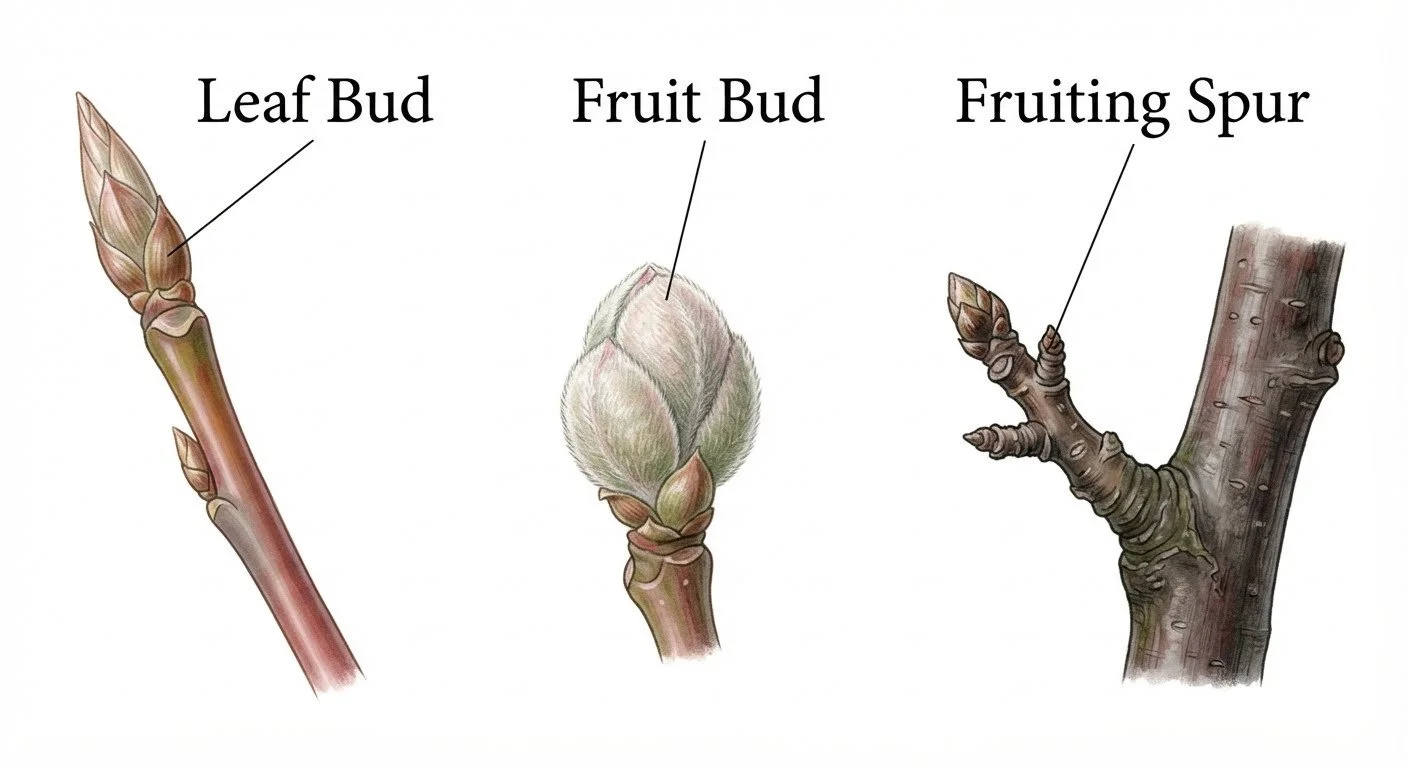
On fruit trees the buds themselves are not all the same.
Leaf (or wood) buds are slender and pointed. They open into shoots that make leaves and more stem — no flowers, no fruit.
Fruit buds are plumper, rounder, and often a little downier. Those are the ones that open into flowers and, if pollinated, fruit. On an apple or pear in late fall or winter you can usually tell them apart with a close look. That distinction matters when you decide what to leave and what to cut.
Fruiting spurs are short, stubby lateral branches made of tightly packed nodes and very short internodes. They form on two-year-old and older wood. On most apples and pears a healthy spur can carry fruit for several years in a row.
Not every apple variety works the same way. Most are spur-bearing: they put the bulk of their crop on those compact spurs along older wood. They tolerate fairly hard pruning without losing much yield. A smaller group are tip-bearing: they fruit mainly at the ends of last year’s shoots. Cut those tips hard and you cut off next year’s crop. A few varieties sit in between. Knowing which type you’re holding before you prune is the difference between a productive tree and one you’ve accidentally cleaned of fruit.
Selecting and Taking a Cutting
Start with healthy wood free of disease or damage. Take the cutting from the middle of a stem, between nodes, and make sure you include at least one node — better two or three — with a few inches of stem above and below. Strip off any leaves or side shoots that would sit under the rooting medium or get in the way.
Here at the Sanctuary we use this same anatomy whether we’re taking softwood cuttings on currants and willows in early summer or hardwood cuttings on many of our woody plants once growth has hardened in late fall. The parts don’t change; the timing and the wood type do.
What’s Next
This anatomy is the foundation for the stem-cutting technique article still to come — selecting wood by season (softwood, semi-hardwood, hardwood), making the cut, and getting roots to form. Until that piece is up, the next useful move is to walk a stem you already have and name the parts out loud: terminal bud, axillary bud, node, internode. If you can’t find a node, don’t take the cutting.
Further Reading
On this site:
Plant Propagation Introduction — the map of methods, including why stem cuttings exist alongside seed and other options.
Plant Hormones — auxin and why pinching a terminal bud changes what the rest of the stem does.
Growing Currant Bushes — a crop we actually multiply from wood here.
Growing Gooseberry Plants — same nursery work, different bush.
If you want one outside reference while you wait on the technique article, Hartmann and Kester’s Plant Propagation is still the book most of us end up checking when a cutting fails and we need to know whether the wood, the season, or the hormone was the problem.